
MJF 3D Printing Services
 Fastest delivery within one day.
Supports high resolution and various materials.
Tolerance accurate to ±0.2 mm.
Fastest delivery within one day.
Supports high resolution and various materials.
Tolerance accurate to ±0.2 mm.





Our MJF 3D Printing Services
Multi-Jet Fusion (MJF) is a widely adopted additive manufacturing technology developed by Hewlett-Packard. It uses thermoplastic polymer powder as a raw material, selectively melting and smelting the powder layer by layer with a heat source to build high-strength functional parts. A key advantage of MJF is its ability to efficiently produce functional prototypes and production parts with excellent isotropy and superior mechanical properties. Therefore, it is widely used in industries such as automotive and aerospace for manufacturing functional components.
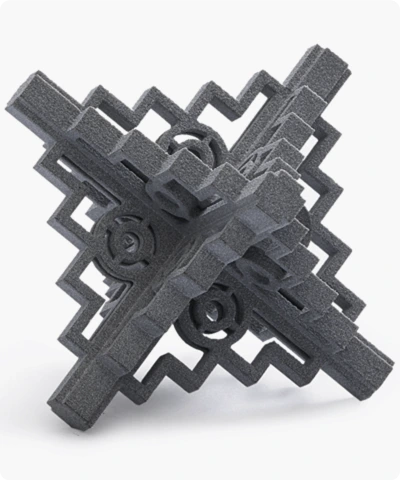
Production Capacity

380mm*284mm*380mm

2-3 business days

±0.2mm/100mm

25-100 um
How does MJF 3D Printing Work?
MJF 3D Printing

Before printing, engineers assess the feasibility of the model, set the batch size, and preset key
parameters. During printing, a layer of polymer powder is evenly applied to the build platform. Then, a
thermal inkjet array selectively applies melt and refiner to specific areas. A heat source melts the powder
where the melt is applied, while the refiner evaporates to prevent unnecessary melting and cools the edges,
ensuring sharp details.
After each layer melts, the build platform reduces its thickness by one layer. This cycle of powder
spreading, reagent application, melting, and cooling is repeated until the part is complete. After printing,
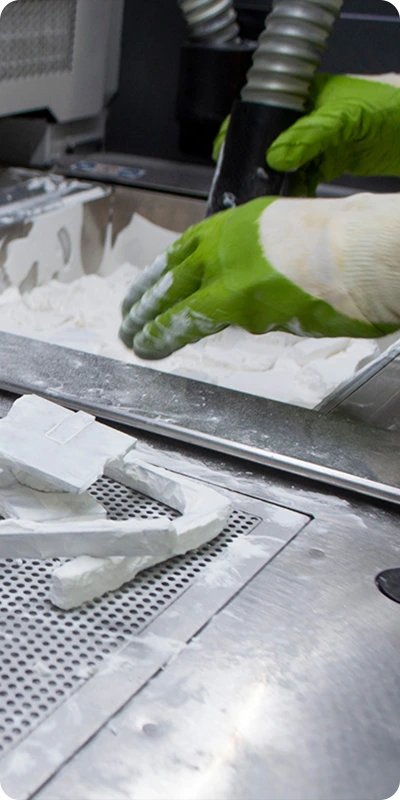
the build chamber is removed and allowed to cool naturally. Excess powder is then removed to expose the
part, which may require further post-processing as needed for production.
Advantages of HLH MJF printing

High Printing Speed
MJF uses zone curing (heating the entire layer at once), allowing multiple parts to be printed simultaneously within the build chamber. This results in faster printing speeds compared to other technologies, making it particularly suitable for medium-precision, high-volume production.

Stable Mechanical Strength
Through uniform heating and complete material melting, MJF parts exhibit balanced strength along the X, Y, and Z axes. Compared to other methods, MJF parts offer better isotropy and stable mechanical properties, making them ideal for high-performance applications.

Superior Surface Quality
The refining agents used in MJF significantly improve edge sharpness. Compared to SLM, FDM, and similar technologies, MJF parts achieve finer surface details, particularly beneficial for applications with high aesthetic requirements.

High Material Utilization
MJF employs a powder bed fusion process, allowing unmelted powder to be sieved and processed for reuse during printing, significantly reducing material waste and effectively lowering production costs.
MJF Material Options
PA 12 Black is a high tensile strength nylon. Final parts are dyed black, and they exhibit quality surface finishes and slightly more isotropic mechanical properties when compared to SLS. When more detail is required, PA 12 can achieve smaller minimum feature resolution (0.02 in) as compared to SLS materials (0.03 in). PA 12 Black is the best material option for designs that incorporate living hinges.
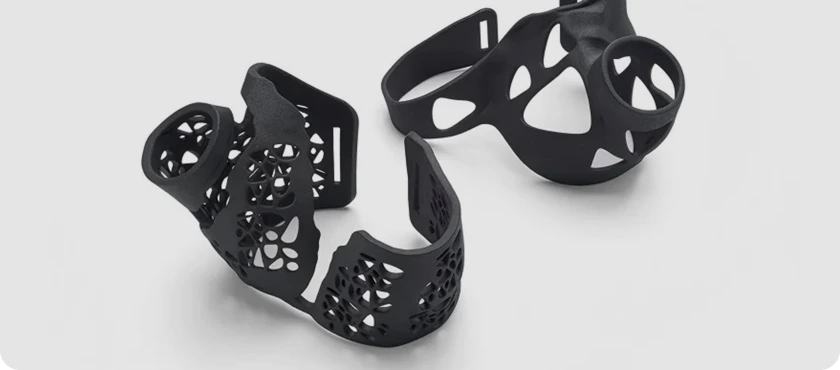
PA 12 40% Glass-Filled Black is a 40% glass-filled nylon. Final parts are dyed black. The biggest advantage offered by this material is heat deflection at 347°F (measured at 66 psi), ranking 2nd best after PA 12 Mineral-Filled.
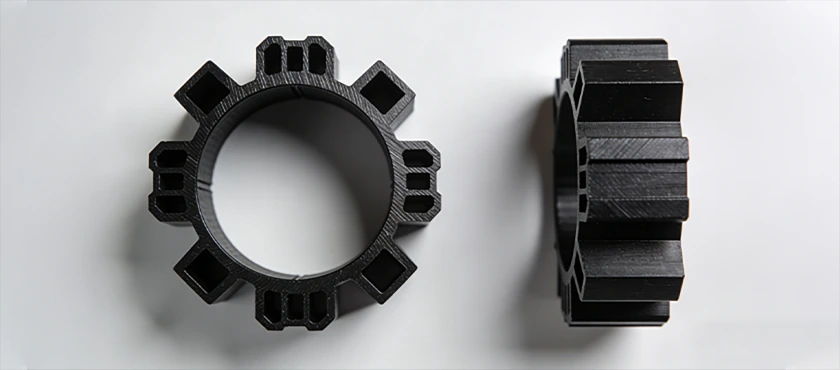
MJF 3D printing post-processing
3D printing surface finishes enhance the appearance, texture, and performance of printed parts. From smoothing to coating, surface finishes improve aesthetics, durability, and functionality, preparing parts for final use or display.

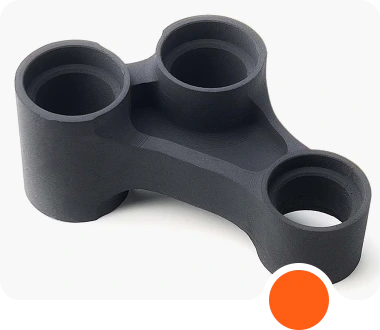
Powder
Removal Using vibration or mechanical equipment to clear unmelted powder from the part’s surface.
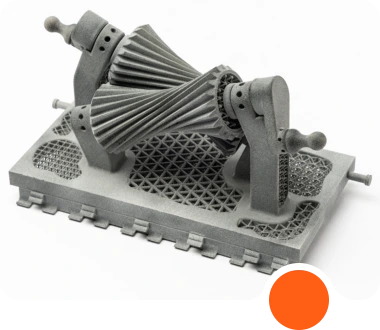
Sandblasting
Blasting fine abrasive particles onto the surface to remove burrs and improve roughness.
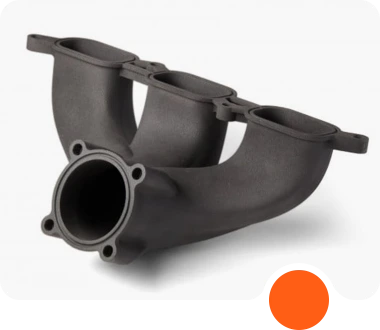
Coloring & Dyeing
Enhancing part appearance through dyeing or painting.
Our Video Display

What Customers are Saying?

Fast and Reliable, Defnitely My First Choice!
"As the owner of a small machining shop, I'm deeply impressed by HLH Model Tech's effciency and reliability. They not only respond quickly tomy urgent needs but also deliver consistently high-quality parts.Especially their customer service team, who always swiftly resolves any issues I face. It's truly a hassle-free experience!"


Custom Transmission Belts, Perfectly Matched!
“HLH Model Tech has exceeded our expectations in delivering high-quality CNC machined parts. Their professional skills and processing production capabilities have seamlessly connected our production needs. ”

Worth Every Penny!
"When choosing suppliers, value for money is always my top consideration. HLH Model Tech not only offers reasonable prices but also ensures exceptional quality. Their team is adept at balancing cost- effectiveness, consistently delivering results that exceed expectations within our budget. They are a lifesaver for our financial planning!"


Request A Quote
Please place file(s) for transfer in the same folder and ZIP or RAR before attaching.
Larger
attachments can
take a few minutes to transfer depending on your local internet speed 🙂
Recent Articles / Blogs
CNC turning services have significant usage in the manufacturing sector; despite that, the inefficiency that pertains to the aspects of quality, on-time delivery, or cost with regard to turning projects is an issue that many organizations face today.